


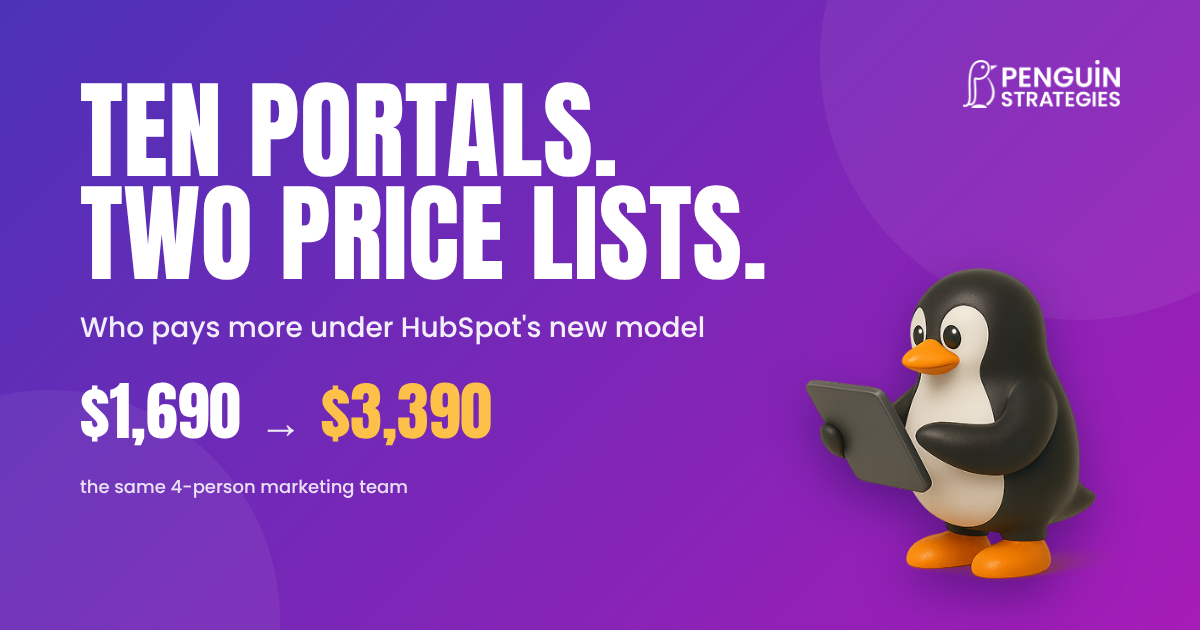
The first portal I priced on the new model doubled.
Four marketers, 15,000 marketing contacts, 60,000 emails a month. On the list HubSpot sells today, that team pays $1,690 a month. On the seats-and-credits list that went live for new EMEA customers on 1 October, the same team pays $3,390. I ran it twice because I assumed I had typed a zero too many. I hadn't.
Last week I wrote that the seat change was the best thing HubSpot has done in five years and that the credits section was where mid-market bills would be decided. Several of you asked for the arithmetic behind that. Fair. So we priced ten portals, from a sales team that only wants one hub to an enterprise running all of them, on both lists, and the marketing team above was portal number two. It set the tone for the rest of the exercise.
One correction before the numbers. In that post I quoted a GTM Seat at €100 and an Ops Seat at €50. HubSpot's published seats-and-credits supplement calls them a Front Office Seat ($120 on Professional, $150 on Enterprise) and a Core Seat ($60 and $90). Those are the prices below, and the right ones.
Why the marketing team doubled
I went looking for the mistake and found a design decision instead. On legacy, that team's 15,000 contacts cost $750 on top of the hub, and the contact tier came with 150,000 sends a month. Email was free once you had paid for the people you were emailing. On the new list the contacts are free and the email is metered: 15 credits a send for the first 10,000, 5 for the next 45,000, 2 after that. Sixty thousand sends works out to 385,000 credits, or $3,850 at pay-as-you-go. The sane buy is the 100,000-send capacity pack at $3,000, so that is what I bought, and it became the single biggest line on the bill. Bigger than the four seats combined.
That pattern held every time email was the main thing a portal did. Portal four, a mid-market SaaS company with six marketers, twenty reps and 150,000 sends, went from $5,090 to $6,280. Portal nine, an enterprise marketing engine sending a million emails a month, went from $5,975 to $7,050, even though the million-send pack is the best unit price in the model at $0.006 an email. Volume senders get a better rate than they ever had. Mid-volume senders get a worse one, and most mid-market portals are mid-volume.
Then the manufacturer came out cheaper
Portal five is the one that changed my read of the model. Thirty reps who quote, eight service people, two ops, 300 accepted quotes a month. On legacy every quoting rep needed a Sales seat and a Revenue seat, $195 a person before anyone sent an email. That was the salesperson in my last post, the one with two licences for one job. On the new list a Front Office Seat at $120 does both. The 300 quotes cost 30,000 credits, the allowance covers a third of them, and the whole bill lands at $5,030 against $6,750. Twenty-five percent less, for the portal type we spend most of our time building.
The enterprise running every hub told the same story at scale. Eighty-five customer-facing people, fifteen marketers, six ops, five hubs that used to carry their own platform fees. Four hundred thousand sends a month bought as a pack, 180,000 billable credits on top, and it still came in at $19,590 against $21,760. The seats absorbed the hub fees, and the hub fees were bigger than the credits.
Portal one is the honest exception. A sales team with no CPQ pays $120 a seat where it paid $100, and there are no credits to offset it. If all you ever wanted was Sales Hub, the new model is a 20% price rise on the person and nothing else changes.
The ten portals
Monthly list, annual terms, no onboarding, no discounts on either side, everything in dollars. One note on that: HubSpot publishes the new list in euros and the legacy list in dollars, and I have kept the published numerals and shown both as USD, so a €120 seat reads as $120 here.
| # | Portal | Legacy | New | Change |
|---|---|---|---|---|
| 1 | Sales only: 12 reps, 1 admin, Pro | $1,250 | $1,650 | +32% |
| 2 | Marketing only: 4 marketers, 15k contacts, 60k sends, Pro | $1,690 | $3,390 | +101% |
| 3 | Sales + Service: 25 reps, 10 agents, 2 ops, Pro | $3,770 | $4,630 | +23% |
| 4 | Marketing + Sales: 6 marketers, 20 reps, 3 ops, 40k contacts, 150k sends, Pro | $5,090 | $6,280 | +23% |
| 5 | Quote-heavy manufacturer: 30 reps on CPQ, 8 service, 2 ops, 300 quotes, Pro | $6,750 | $5,030 | −25% |
| 6 | Professional services: 3 marketers, 10 partners, 1 ops, 8k contacts, 15k sends, Pro | $2,440 | $2,740 | +12% |
| 7 | Service-led: 20 agents, 2 ops, 2,000 AI-agent conversations, Pro | $3,070 | $3,570 | +16% |
| 8 | Integration-heavy: 15 reps, 5 service, 4 ops, Data Hub, 200k workflow actions, Pro | $2,950 | $2,790 | −5% |
| 9 | Enterprise marketing: 10 marketers, 250k contacts, 1M sends, Enterprise | $5,975 | $7,050 | +18% |
| 10 | All hubs: 15 marketers, 60 reps, 25 service, 6 ops, 400k sends, Enterprise | $21,760 | $19,590 | −10% |
None of these is a real client. All of them look like one.
What I would do with a quote in hand
Count your sends and workflow actions by month for the last year before you read the seat line. Under 10,000 sends, the included credits and a 2,000-send pack will do, and your bill is mostly seats. Up to about 50,000, one 10,000-send pack plus pay-as-you-go is the cheapest buy, somewhere between $0.05 and $0.10 an email. Above 50,000 you are buying the $3,000 pack whether you like it or not, so spend your negotiating energy on the seats. Past 100,000, the packs are the best deal in the model and you should stop complaining.
Then count the people who talk to customers against the people who build. Every Front Office Seat you can turn into a Core Seat saves $60 a month on Professional. Marketing, ops and RevOps do not need Front Office. Check who is on the quote before you sign it.
The ten portals, with every assumption behind them, are in the calculator below. Put your own numbers in. If your portal lands somewhere different from mine, I want to see the inputs.
Open the HubSpot pricing calculator
This came out of a client project. The story behind it, and what to check in your own portal, goes to subscribers on Thursdays. Get Thursday's note.
by Perry Nalevka on October 14, 2026
CEO of Penguin Strategies