
A field is a specialist job
You can't add one and be confident it won't trip a validation rule three objects away. So it goes to someone who knows, and someone who knows has a queue.



We sell outcomes. Not hours.
Adding a field means a ticket, a specialist and a wait. That is the cost that moves companies off Salesforce.
 Elite tier. Accredited by HubSpot for Data Migration and CRM Implementation.
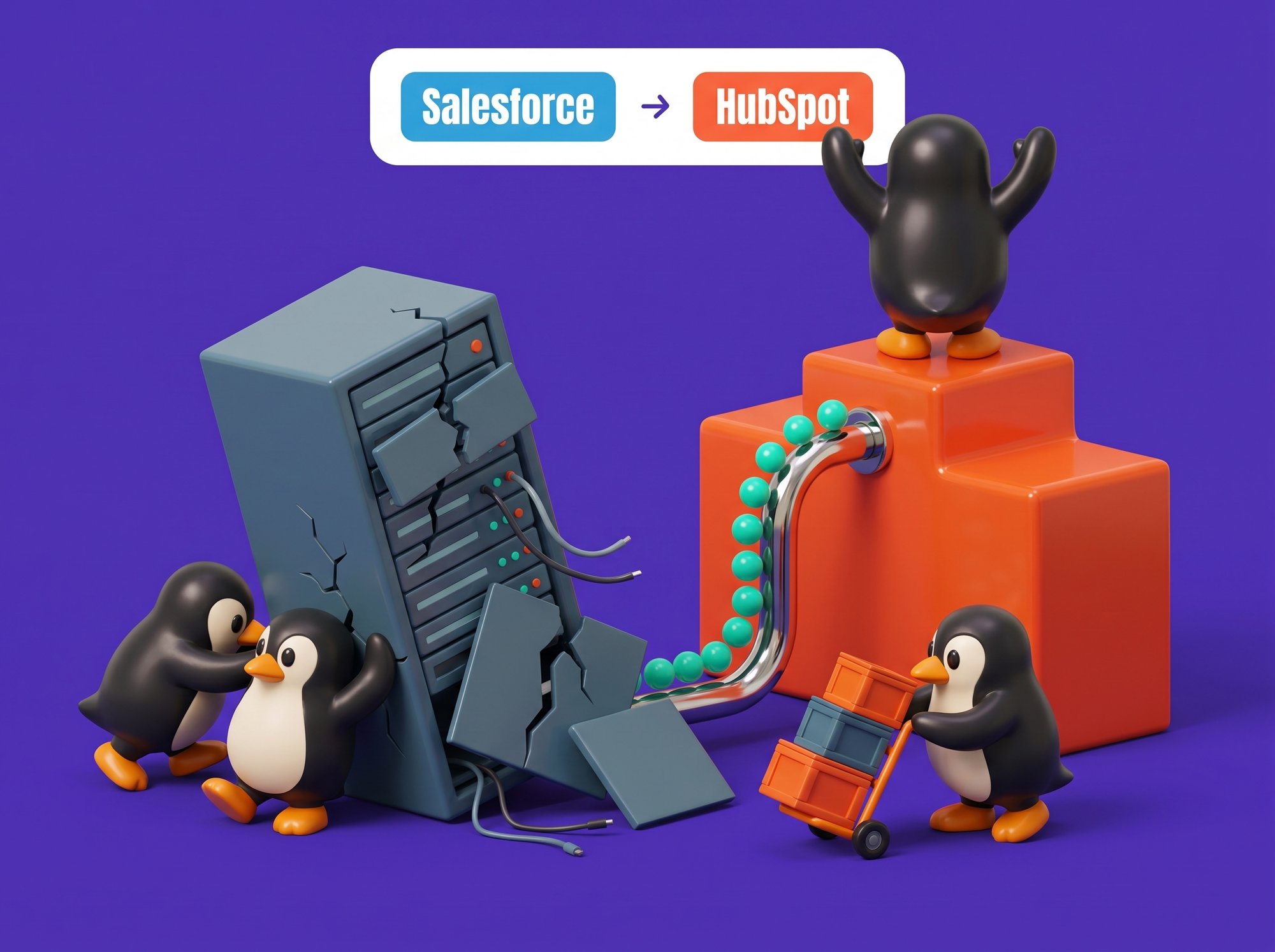
Penguin Strategies moves B2B companies off Salesforce and onto HubSpot. CRM, marketing, sales and service, with the integrations, the automation and the reporting rebuilt rather than copied across. We are a HubSpot Elite Solution Partner holding HubSpot's Data Migration and CRM Implementation accreditations. We have moved 8.7 million data points across 40 teams in three regions with zero downtime at go-live.
Why teams actually leave
It holds the data. The reports run. Nothing is on fire, so the migration conversation never gets past "one day". The expensive part is that the system can no longer keep up with the business it runs.
Change requestsSalesforce
Next available admin slot: three weeks
Same four changesHubSpot
Same afternoon
You can't add one and be confident it won't trip a validation rule three objects away. So it goes to someone who knows, and someone who knows has a queue.
An admin on staff, a partner on call, or both. You are paying that every month whether or not anything shipped.
Spreadsheets, notebooks, a private pipeline in Slack. The CRM asks for more than it gives back, so they keep their own version of the truth.
Leadership asks something reasonable about pipeline. Three weeks later there's a report, and by then the question has changed.
After the move
Fields, stages, routing, lifecycle logic. Your ops lead does it in the interface, not in a ticket.
When the CRM is faster than the workaround, the workaround stops. Reps keep one pipeline because one is easier.
Marketing, sales and service on the same objects, so the pipeline question has one answer instead of three.
Scoping
A migration that copies your Salesforce org into HubSpot gives you your problems back in a new interface. Every object gets sorted into one of three piles before anything moves.
Territories, approval paths, renewal mechanics, anything finance or legal depends on. This is the part worth the care, and it gets rebuilt properly.
Custom objects and automations that exist because Salesforce needed them to. Native functionality replaces them, and the maintenance goes away with the workaround.
Every org carries them. We show you the list and you decide, but a migration is the one moment when deleting them is free.
Who has done this with you?
"Migrating from Salesforce to HubSpot was a huge, complex project, but Penguin managed it end-to-end."
Yuli Moldavsky · Sr. Director, MIS & InfoSec, Rapyd
Six months, covering CRM, marketing, sales, service, compliance and operations. If the reason you haven't moved is that your org is too complicated, this is the answer to that.
How it runs
Four phases with a sign-off gate at the end of each one. You approve the design before anything is built, and the build before anything is switched.
Every integration the Salesforce org touches gets inventoried before a single record moves: ERP, CPQ, billing, fulfillment, enrichment. Then the object model, and the three piles above.
Gate: you sign off the blueprint
Properties, pipelines, automation and integrations built in HubSpot. Data moves in several tested passes and gets validated against source counts each time.
Gate: you sign off the build
Teams trained on the system they'll actually use, with process guides written for their role. Cutover is planned to the day, with a rollback that exists on paper before it's needed.
Gate: go / no-go with you
We stay on it after launch, when the questions no amount of testing surfaces start arriving from real users in real deals.
Then: ongoing support, or you run it
Published, before you call us
It depends on how many hubs, how much data, and how many systems are wired to your Salesforce org. Here is the shape of it anyway, because nobody can plan a year around "it depends".
Sales or marketing, clean data model, the integrations you can't live without. The smallest honest version of this project.
What moves the number: 1 hub, starting fresh.Two hubs, real automation, several integrations, history that has to arrive intact. Where most of these land.
What moves the number: 2 hubs, one legacy migration.CRM, marketing, sales and service together, multi-region teams, compliance in scope. The Rapyd shape.
What moves the number: 4 hubs, legacy migration, CPQ, custom integrations.Run your own numbers on the migration calculator. No email required. If a real project lands outside the range, we fix the model. Not the invoice.
Straight answer
Four situations where we'd tell you to wait, and have.
Questions we get
Run the calculator, see the math, then bring us a question about the number.



+972-54-819-1655
info@penguinstrategies.com
4 Dolev Street, Ra'anana, Israel